
AI Chatbot vs Live Chat: Which Converts Better? (2026 Guide)

A visitor lands on your website, explores your services and becomes interested in working with you. But before taking the next step, they have one question.
Do you serve their area? How much does your service cost? How long will the project take?
If they can find the answer quickly, they may contact you. If they cannot, they might leave your website and look for a competitor who makes the decision easier.
This is where website chat can make a real difference.
But should you use a human-powered live chat system or an AI chatbot that answers visitors automatically? And which option is more likely to turn website visitors into qualified leads and paying customers?
The answer depends on your business, your audience and the type of questions your customers ask.
In this guide, we compare AI chatbot vs live chat across response speed, cost, lead generation, customer trust and conversion potential. You will also learn when each option works best, how a hybrid chat support system combines both approaches, and how to choose the right solution for your business.
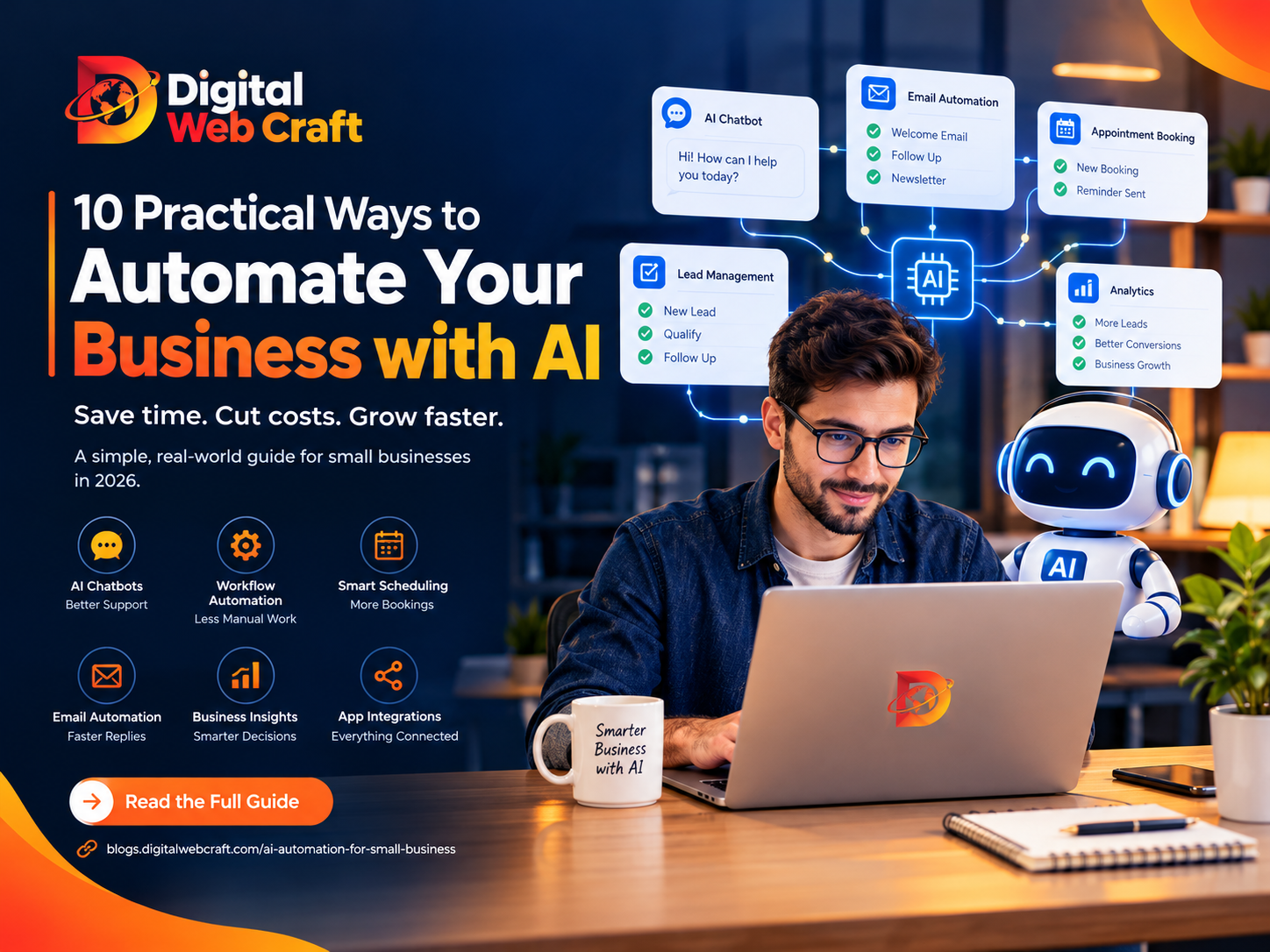
If you are exploring ways to improve business efficiency, read our guide to 10 Practical Ways to Automate Your Business with AI.
Table of Contents
- The Short Answer
- What Is Live Chat?
- What Is an AI Chatbot?
- How Website Chat Improves Conversions
- AI Chatbot vs Live Chat: Key Differences
- Response Speed and Availability
- Cost and Scalability
- Answer Quality and Accuracy
- Lead Capture and Qualification
- Customer Trust and the Human Touch
- Complex Questions and Sensitive Conversations
- Reporting and Customer Insights
- When Live Chat Is the Better Choice
- When an AI Chatbot Is the Better Choice
- Why Hybrid Chat Support Can Work Best
- Examples Across Different Industries
- How to Choose the Right Chat Solution
- How to Set Up Website Chat That Converts
- Common Mistakes to Avoid
- How to Measure Chat Performance
- Frequently Asked Questions
- Final Thoughts
1. The Short Answer
There is no universal winner in the AI chatbot vs live chat debate. Each option serves a different purpose.
Live chat is often the better choice when:
- Customers need personal guidance before making a high-value purchase.
- Questions require human judgment or detailed explanations.
- Trust and relationship-building are important.
- Your team can respond promptly during advertised hours.
An AI chatbot is often the better choice when:
- Visitors ask repetitive questions about services, pricing or availability.
- You receive enquiries outside normal business hours.
- Your team needs to handle multiple conversations simultaneously.
- You want to capture and qualify leads automatically.
Hybrid chat support is worth considering when you want both. An AI chatbot can answer common questions and collect initial details, while a human takes over conversations that require personal attention.
For many small businesses, a hybrid setup is a practical starting point because it balances automation with human support. However, the best choice depends on your actual enquiry volume, budget and customer expectations.
The key principle is simple: help visitors get the right answer quickly, make it easy to contact a real person, and give them a clear next step.
2. What Is Live Chat?
Live chat is a website messaging tool that allows visitors to communicate with a real person from your business.
A chat widget appears on your website. When someone asks a question, a team member receives the message through a dashboard, desktop application or mobile app and responds.
For example, a visitor exploring a web design agency might ask, “Can you redesign my existing website and keep my current content?”
A team member can ask follow-up questions, understand the visitor’s goals and recommend a suitable service.
How live chat works
- A visitor opens the chat widget.
- They type a question about your business.
- A team member receives and answers the message.
- The conversation is stored for reference or follow-up, depending on the software.
- The team member can guide the visitor towards a consultation, booking or purchase.
Advantages of live chat
- Human judgment: Team members can understand context and handle unusual requests.
- Personal communication: Visitors can speak directly with someone who understands the business.
- Flexible sales conversations: Staff can explain services, discuss requirements and answer follow-up questions.
- Relationship-building: Personal interaction can help customers feel more comfortable making a decision.
Disadvantages of live chat
- Someone must be available to answer messages.
- Response times can increase when the team is busy.
- Covering evenings and weekends may require additional staffing.
- Conversation quality can vary between team members.
- Enquiries may be missed if notifications are overlooked.
Live chat can be highly effective, but only when your business can manage it consistently.
3. What Is an AI Chatbot?
An AI chatbot is software that interacts with website visitors and automatically responds to their questions.
Modern AI chatbots can understand everyday language, use information from approved business documents and ask follow-up questions to understand what a visitor needs.
Unlike older rule-based bots that rely on fixed menus, AI-powered systems can often handle a wider variety of naturally phrased questions. Their capabilities depend on the underlying technology, available information and integrations.
What can an AI chatbot do?
A well-configured customer support chatbot can:
- Answer frequently asked questions about services and policies.
- Explain pricing information that your business has approved.
- Collect names, email addresses and enquiry details.
- Qualify leads based on service requirements and project timelines.
- Share booking links or help visitors request an appointment.
- Direct visitors to relevant website pages.
- Summarise conversations for your team.
- Transfer conversations to a human when necessary.
For example, a visitor might ask, “I need a new website for my cleaning business. Can you help?”
The chatbot could explain your web design services, ask about the number of pages required, collect a preferred contact method and offer a link to your project enquiry form.
Advantages of AI chatbots
- Immediate responses to supported questions.
- Availability outside normal business hours.
- Ability to handle multiple conversations at once.
- Consistent lead qualification.
- Automatic collection of relevant enquiry details.
- Reduced manual work on repetitive enquiries.
Disadvantages of AI chatbots
- Incorrect answers can damage customer trust.
- Poorly configured systems may misunderstand questions.
- Complex or sensitive conversations still require human involvement.
- Setup, testing and maintenance take time.
- Software, usage and integration costs can add up.
An AI chatbot is not automatically effective just because it uses artificial intelligence. Its performance depends on the quality of its information, its limitations and how well it fits your customers’ needs.
4. How Website Chat Improves Conversions
Before comparing the two options, it helps to understand why website chat can influence conversions.
A conversion might mean a completed purchase, a consultation booking, a quote request or a qualified sales enquiry. The right outcome depends on your business model.
It removes uncertainty
Visitors often hesitate because they cannot find a specific answer. Chat gives them another way to get the information they need without searching through multiple pages.
It reduces friction
Some visitors would rather ask a quick question than complete a long contact form. A short conversation can make the next step feel easier.
It captures buying intent
Someone asking about pricing, delivery times or project availability may be closer to making a decision than someone casually browsing.
A useful conversation can help that visitor move forward.
It provides timely assistance
A quick and relevant answer can prevent a visitor from abandoning the enquiry while waiting for information.
It reveals problems with your website
Repeated questions may show that your pricing page is unclear, your service descriptions are incomplete or your contact process is confusing.
You can use those insights to improve your website content and customer journey.
However, chat does not guarantee more sales. Results depend on traffic quality, the value of your offer, website usability and how effectively your business follows up.
For stronger results, combine chat with a well-designed website and clear calls to action. Explore our web design and digital services to learn more.
5. AI Chatbot vs Live Chat: Key Differences
The following comparison highlights the main differences between the two approaches.
| Factor | Live Chat | AI Chatbot |
|---|---|---|
| Response time | Depends on staff availability | Usually immediate for supported requests |
| Availability | Based on staffing hours | Can operate around the clock |
| Staffing needs | Requires a person to respond | Automates initial conversations |
| Scalability | Limited by agent capacity | Can handle multiple chats simultaneously |
| Routine questions | Handled manually | Often suitable for automation |
| Complex questions | Human judgment is available | May require escalation |
| Personal interaction | Direct human communication | Automated interaction |
| Lead qualification | Depends on agent workflow | Can follow a consistent sequence |
| Setup | Often straightforward | Requires configuration and testing |
| Ongoing costs | Staff time and software | Software, usage, maintenance and integrations |
| Reporting | Depends on the platform and team | May offer automated categorisation and summaries |
| Best suited for | Personal, complex or high-value conversations | Routine enquiries, initial qualification and after-hours support |
The best option is not necessarily the one with the most features. It is the one that fits your customers and helps your team deliver a better experience.
6. Response Speed and Availability
Response speed is one of the strongest advantages of an AI chatbot.
Visitors may arrive on your website early in the morning, late at night or during weekends. If your team is unavailable, a live chat message might remain unanswered until the next working day.
An AI chatbot can answer supported questions immediately, even when your staff are busy.
For example, a visitor might want to know whether your agency offers website maintenance. A chatbot can provide the approved service information and direct them to the relevant page without requiring a team member to interrupt their work.
Live chat can also be fast when you have dedicated staff, reliable notifications and clear coverage hours. In fact, a human may provide a more useful response when the visitor has a complicated question.
The problem occurs when a business advertises live chat but rarely responds.
A chat widget that promises immediate assistance and then leaves customers waiting can create frustration.
Verdict: AI chatbots have the advantage in availability and handling routine enquiries at scale. Live chat remains competitive when your team can consistently provide quick, helpful responses.
7. Cost and Scalability
The cost difference between AI chatbots and live chat depends on your enquiry volume, staffing arrangements and chosen software.
Live chat costs
Live chat typically involves:
- Staff salaries or the cost of employee time.
- Customer support or sales software.
- Training and conversation management.
- Additional coverage if you need evening or weekend availability.
For a small business receiving only a few enquiries each day, responding personally may be affordable and straightforward.
As enquiry volume increases, however, your team may struggle to keep response times low without dedicating more resources to chat.
AI chatbot costs
AI chatbot costs may include:
- Initial setup and configuration.
- A software subscription or usage-based fees.
- Preparing and maintaining business information.
- CRM, booking or other integrations.
- Testing, monitoring and ongoing improvements.
Once configured, a chatbot can handle additional conversations without requiring a separate employee for every chat.
That can make it more economical for repetitive, high-volume enquiries. However, costs vary significantly between providers, and human review is still necessary.
Which is more affordable?
For very low traffic, human-powered live chat may be the simplest option.
For repetitive enquiries at higher volumes, an AI chatbot may reduce the amount of staff time required.
For complex sales, a hybrid model may provide the best balance between operating cost and personalised service.
Verdict: Compare the total cost of running each system, not just the monthly software subscription.
8. Answer Quality and Accuracy
Answer quality is one of the most important considerations when choosing a chat solution.
Human agents can interpret context, ask clarifying questions and recognise when a situation needs special attention.
AI chatbots can provide consistent answers to common questions, but only when they have suitable information and appropriate instructions.
How AI chatbots get answers wrong
A chatbot may produce an inaccurate answer when:
- Your service information is incomplete.
- Pricing or policies have changed.
- Different pages contain conflicting details.
- The system is allowed to answer questions beyond its knowledge.
- A visitor asks something ambiguous or unusual.
For example, if your website lists a starting price but does not explain what affects the final quote, a chatbot might incorrectly present the starting price as the total cost.
That misunderstanding could create unrealistic expectations and lead to disputes later.
How to improve chatbot accuracy
- Use current service descriptions, FAQs and approved business documents.
- Give the chatbot clear instructions about what it can and cannot answer.
- Tell it to acknowledge uncertainty instead of guessing.
- Prevent it from inventing prices, guarantees, policies or delivery dates.
- Provide an easy way to contact a human.
- Review conversations regularly and correct recurring mistakes.
Human agents also need accurate information and training, but they can use judgment to recognise when they should investigate a question before responding.
Verdict: Live chat is generally better for unusual or nuanced situations. AI chatbots are useful for routine questions when their information is accurate and their limitations are clearly defined.
9. Lead Capture and Qualification
For many small businesses, the primary goal of website chat is not answering support questions. It is generating qualified leads.
A lead is a potential customer who has shown interest in your product or service. A qualified lead has enough relevant information to help your team decide how to proceed.
Lead capture with live chat
A human agent can have a natural conversation, understand the visitor’s needs and identify opportunities.
For example, an agency owner might discover that a visitor needs a new website, has a defined budget and wants to launch within a month.
The agent can recommend the right service and arrange a consultation.
However, manually collecting information can be inconsistent when staff are busy or several conversations are happening at once.
Lead capture with an AI chatbot
An AI chatbot can follow a consistent qualification process.
It might ask:
- What service are you interested in?
- Are you starting a new project or improving an existing one?
- When would you like to get started?
- What is the best way for our team to contact you?
Depending on the setup, the chatbot can send these details to a CRM, email inbox or lead management system.
This makes it easier to organise enquiries and follow up.
How to capture better leads
Avoid asking visitors to provide a long list of details before offering any value.
Instead, ask one relevant question at a time and explain why the information is useful. Collect only the personal information your business genuinely needs.
For high-value enquiries, allow a human to review the information and continue the conversation.
Verdict: AI chatbots are useful for consistent, structured lead capture. Live chat can be stronger when qualification depends on deeper discussion and personal judgment.
10. Customer Trust and the Human Touch
Customer trust matters when visitors are deciding whether to share their details, book a consultation or spend money.
Some customers are comfortable interacting with an AI chatbot. Others prefer speaking to a real person, particularly when the decision is expensive or complicated.
Neither preference should be ignored.
How live chat builds trust
Human agents can communicate naturally, respond to concerns and explain decisions in context.
They can also acknowledge when they need to check something rather than forcing an immediate answer.
This is especially valuable when customers have doubts about a service or need reassurance before committing.
How an AI chatbot can maintain trust
An AI chatbot can still create a positive experience if it is transparent and useful.
Follow these practices:
- Introduce it honestly as a virtual assistant.
- Use clear, natural language.
- Provide accurate information.
- Avoid pretending that an automated response comes from a human.
- Offer a visible way to contact your team.
- Explain what happens when a conversation is transferred.
- Respect customer privacy and data preferences.
For example, an opening message could say:
“Hi! I’m the virtual assistant for Digital WebCraft. I can help with our services and project enquiries, or connect you with our team.”
This tells visitors what to expect without misleading them.
Verdict: Live chat offers direct human connection. A transparent chatbot can still build confidence when it provides useful answers and makes human assistance easy to access.
11. Complex Questions and Sensitive Conversations
Not every conversation should be automated from beginning to end.
Some situations require empathy, professional judgment or the authority to make decisions.
Examples include:
- A customer complaining about a failed delivery.
- A client negotiating a large project.
- A billing dispute or refund request.
- A visitor asking for advice involving sensitive personal circumstances.
- A complaint that requires an exception to company policy.
- A technical issue that requires detailed investigation.
An AI chatbot can still help by collecting basic information, recording the issue and routing it to the appropriate team member.
However, it should not attempt to resolve every situation independently.
For sensitive topics, businesses should also consider applicable privacy requirements and avoid collecting unnecessary personal information.
Verdict: Human support is generally the better choice when a conversation requires empathy, discretion or decisions beyond the chatbot’s authority.
12. Reporting and Customer Insights
Both live chat and AI chatbots can help you understand what visitors need, depending on the software and reporting tools available.
Insights from live chat
Human agents often notice recurring customer concerns.
They might discover that visitors repeatedly ask about pricing, project timelines or what is included in a service package.
These observations can help improve sales conversations and website content, but they may be lost if conversations are not documented.
Insights from AI chatbots
AI-powered chat platforms may offer structured reports, conversation summaries and categories.
These can help you identify:
- The most common questions.
- The pages that generate enquiries.
- Where visitors abandon conversations.
- Which questions the chatbot cannot answer.
- How often conversations require human assistance.
- Which enquiry types generate qualified leads.
The usefulness of these reports depends on the platform, tracking setup and quality of the data.
Turn insights into improvements
Suppose visitors repeatedly ask whether website maintenance is included in a package.
Instead of relying on the chatbot to answer the same question forever, improve the package page so the information is easier to find.
Your chat system then becomes a source of customer research, not just a messaging tool.
Verdict: AI chatbots may make reporting and categorisation easier, while human agents provide valuable qualitative insights. Combining both can help you improve the entire customer journey.
13. When Live Chat Is the Better Choice
Live chat may be the right option when personal interaction matters more than automation.
High-value services
Consulting, custom development and large B2B projects often involve detailed discussions. A human can understand the requirements and recommend a suitable solution.
Customers need reassurance
If visitors are unfamiliar with your brand or worried about making the wrong decision, a knowledgeable person can help build confidence.
Every enquiry is different
Businesses with highly customised services may receive questions that are difficult to answer through a standardised chatbot workflow.
Your enquiry volume is manageable
If you receive only a few messages each day, handling them personally may be more practical than investing in a complex automation system.
You can respond promptly
Live chat works best when your business can meet the response expectations it sets.
If you cannot provide coverage throughout the day, consider displaying your available hours and offering an alternative enquiry method outside those hours.
14. When an AI Chatbot Is the Better Choice
An AI chatbot may be more suitable when your business needs to answer common questions consistently and capture enquiries at different times of the day.
You receive repetitive questions
Opening hours, service availability, basic pricing information and frequently asked questions are often suitable for automation.
Visitors arrive outside business hours
A chatbot can answer supported questions and collect enquiry details while your team is unavailable.
Your team is small
A business owner may not have time to monitor a chat window while managing projects, sales and operations.
An AI chatbot can handle initial conversations without requiring constant manual attention.
You need structured lead qualification
A chatbot can ask consistent questions and organise information before a team member follows up.
You experience traffic spikes
When marketing campaigns generate more enquiries than your team can handle, automation can help manage the initial workload.
You serve customers in different time zones
An always-available chatbot can provide initial assistance regardless of your team’s working hours.
Verdict: An AI chatbot is particularly useful for repetitive questions, initial qualification and after-hours lead capture, provided there is a reliable process for unanswered or complex enquiries.
15. Why Hybrid Chat Support Can Work Best
For many small businesses, the most practical solution is to combine AI automation with human support.
This approach is called hybrid chat support.
Instead of forcing every visitor to interact with a person or a bot, you let each handle the conversations that suit its strengths.
How a hybrid chat system works
Step 1: The chatbot responds first.
When a visitor opens the chat, the AI assistant welcomes them and asks what they need.
Step 2: It answers routine questions.
The chatbot uses approved business information to explain services, processes and common policies.
Step 3: It qualifies the enquiry.
When appropriate, it asks a few relevant questions to understand the visitor’s requirements.
Step 4: It offers human assistance.
If the visitor requests a person, asks a complex question or expresses frustration, the system offers a human handover.
Step 5: It handles after-hours enquiries responsibly.
When staff are unavailable, the chatbot can collect the request and explain when the team expects to respond. It should not promise a response time your business cannot meet.
Step 6: It records the conversation.
Where the software supports it, the system stores the relevant details and sends a summary to your team.
Why hybrid chat support works
- Visitors receive an immediate first response.
- Staff spend less time answering repetitive questions.
- Leads can be captured outside working hours.
- Customers can request personal assistance.
- Human agents receive useful context before taking over.
- Conversation data can reveal opportunities for improvement.
What makes a hybrid setup successful?
First, define clear handover rules. Do not make customers repeat information they have already shared.
Second, ensure the team receives notifications when a lead needs attention.
Third, keep the chatbot’s information accurate.
Finally, measure whether the system is improving lead quality and customer experience rather than simply increasing the number of conversations.
A hybrid system is not automatically the best choice for every business, but it is a strong option when you need both efficiency and personal service.
16. Examples Across Different Industries
The right approach depends on the type of business and the questions customers typically ask.
Web design and development agencies
An AI chatbot can explain website packages, collect project requirements and share a consultation link.
A human can then discuss the scope, recommend a solution and prepare a proposal.
Ecommerce stores
A chatbot can answer common questions about shipping, returns and product details.
Human agents can handle complicated orders, complaints and situations requiring an exception to standard policy.
Clinics and appointment-based services
Automation can help with opening hours, appointment procedures and general administrative information.
Medical questions and sensitive situations should be directed to qualified staff through an appropriate process.
Real estate agencies
A chatbot can collect information about preferred locations, budget and property requirements.
Agents can follow up to arrange viewings, discuss options and negotiate.
Software and SaaS businesses
A chatbot can answer questions about features, pricing plans and basic troubleshooting.
Technical specialists can handle difficult support issues and detailed product discussions.
Local service businesses
Plumbers, electricians, cleaners and other local service providers can use a chatbot to collect the type of job, location and preferred appointment time.
The business owner can then review the request and contact the customer.
In each case, automation should make the customer journey easier rather than introduce unnecessary steps.
17. How to Choose the Right Chat Solution
Use the following questions to identify the best starting point for your business.
Question 1: How many enquiries do you receive?
If you receive only a few enquiries daily, human support may be enough.
If enquiries are frequent or arrive at unpredictable times, automation may help your team manage them.
Question 2: How complicated are the questions?
If most questions are repetitive, an AI chatbot is worth considering.
If most enquiries involve custom requirements, negotiation or detailed advice, prioritise human support.
Question 3: What is the value of each customer?
When each customer represents a significant business opportunity, make sure qualified leads can reach a knowledgeable person quickly.
For routine, high-volume enquiries, automation may reduce the manual workload.
Question 4: Can you staff live chat reliably?
If your team can respond promptly during clearly stated hours, live chat may work well.
If you are often unavailable, an AI chatbot with a reliable follow-up process can cover the gaps.
Question 5: When do visitors contact you?
Review your website traffic and enquiry records. If a meaningful share of enquiries arrives outside your working hours, consider providing automated initial assistance.
Question 6: What does your audience prefer?
Some audiences value personal contact. Others prefer immediate answers without speaking to anyone.
Use customer feedback and your own conversion data to guide your decision.
A practical recommendation
- Solo business owner: Start with a simple chatbot that answers common questions and captures enquiries, or use live chat if you can reliably respond.
- Growing small business: Consider hybrid chat support to manage routine enquiries while preserving human assistance.
- High-value consultancy or agency: Prioritise access to knowledgeable staff, with AI handling initial questions and after-hours requests.
- High-volume support operation: Evaluate automation for routine requests while keeping clear escalation paths for complex cases.
Choose the simplest solution you can maintain properly, then expand when your data shows a need.
18. How to Set Up Website Chat That Converts
Choosing the right software is only part of the process. The way you implement it also matters.
1. Place chat on relevant pages
Consider adding chat to service pages, pricing pages, product pages and other parts of your website where visitors may need help making a decision.
Test different placements to determine which generate useful enquiries without distracting visitors.
2. Write a helpful opening message
A generic message such as “How can I help?” is acceptable, but a more specific message can guide visitors.
For example:
“Have a question about our services, pricing or project timelines? I can help you find the right information.”
Make sure the wording accurately reflects what the chatbot can do.
3. Avoid interrupting visitors
Do not immediately cover the screen with a chat invitation as soon as someone arrives.
Give visitors an opportunity to explore the page before prompting them to start a conversation.
4. Optimise for mobile devices
Check that the chat widget does not cover important buttons, menus or form fields.
Test it on real mobile devices and make sure visitors can open, use and close it comfortably.
5. Keep responses concise
Long, complicated responses can be difficult to read in a chat window.
Provide the essential information first, then offer a link or ask a relevant follow-up question.
6. Give visitors a clear next step
Depending on the conversation, the next step might be booking a consultation, requesting a quote, viewing a service page or contacting your team.
Avoid ending conversations without explaining what the visitor can do next.
7. Ask for contact details naturally
Do not demand a name, phone number and email address before answering a simple question.
Provide useful information first, then request only the details needed for a follow-up.
8. Make human assistance easy to find
Give visitors a clear way to contact a person. If the team is unavailable, explain how to leave a message and when they can reasonably expect a response.
9. Train the chatbot using real business information
Use your current service pages, FAQs, policies and other approved documents.
Review the information regularly so that the chatbot does not rely on outdated details.
10. Test and improve the experience
Ask the chatbot common questions, unusual questions and questions with missing information.
Check whether it answers accurately, admits uncertainty and transfers conversations when appropriate.
Review real conversations after launch and make improvements based on what customers actually ask.
If you want to explore an AI solution tailored to your website, start with our free AI Project Planner or contact the Digital WebCraft team for guidance.
19. Common Mistakes to Avoid
Even a good chat platform can create a poor customer experience if it is implemented incorrectly.
Launching a chatbot without reliable information
A chatbot cannot consistently answer business questions if its source material is incomplete or outdated.
Prepare and review your knowledge base before launch.
Letting the chatbot guess
Configure the system to acknowledge uncertainty and direct visitors to a person when it cannot provide a reliable answer.
Hiding the human option
Customers should not have to fight through endless automated replies to contact your team.
Offering live chat without staffing it
If nobody can answer, display your availability clearly and offer an alternative contact method.
Asking too many questions
Long qualification sequences can discourage visitors from completing an enquiry.
Ask only what is needed to provide help or arrange an appropriate follow-up.
Ignoring mobile users
A chat widget that covers important content can make your website harder to use.
Test the full experience on mobile devices.
Pretending the chatbot is human
Be transparent about automation and explain when a real team member becomes involved.
Ignoring conversation reports
Unanswered questions and abandoned conversations may reveal problems with your website, chatbot or sales process.
Review them and make improvements.
Neglecting privacy
Explain how you collect and use personal information, limit unnecessary data collection and follow applicable privacy requirements.
Avoid requesting sensitive information through a general-purpose chat widget unless an appropriate, secure process is in place.
Copying competitors without testing
A chat flow that works for another business may not suit your customers.
Test your own setup and make decisions based on actual results.
20. How to Measure Chat Performance
To determine whether your AI chatbot or live chat system is working, track a small set of meaningful metrics.
Chat start rate
The percentage of website visitors who start a conversation.
This helps you understand whether visitors are engaging with the chat option.
Lead capture rate
The proportion of chat conversations that produce a usable lead.
Define what counts as a lead before comparing results.
First response time
The time between a visitor’s first message and the first meaningful response.
For AI chatbots, distinguish automated responses from the time it takes to reach a human when necessary.
Resolution rate
The proportion of conversations that reach a satisfactory outcome without further assistance.
Do not count an unanswered question as resolved simply because the chatbot ended the conversation.
Human handover rate
The percentage of chatbot conversations transferred to a team member.
Review why handovers occur. A high rate may be appropriate for complex enquiries, while repeated transfers caused by missing information may indicate a problem.
Chat-to-conversion rate
The proportion of chat conversations that lead to your defined business outcome, such as a qualified enquiry, booked consultation or purchase.
Track the outcome consistently and allow enough time for sales follow-up.
Customer satisfaction
Ask visitors for brief feedback after a conversation.
A simple rating can help identify whether the system is useful or frustrating.
Revenue influenced by chat
Where your tracking setup permits, connect conversations to leads and sales to understand their commercial contribution.
A simple 30-day improvement plan
Days 1–30: Record your existing chat performance, including response times, enquiries, lead quality and conversions.
Days 31–60: Change one important element, such as the opening message, chatbot knowledge base or after-hours workflow.
After the change: Compare results using the same definitions and similar traffic conditions. Look for meaningful trends rather than drawing conclusions from a handful of conversations.
Remember that visitors who use chat may already have stronger buying intent. Compare results carefully and avoid assuming that chat alone caused every conversion.
21. Frequently Asked Questions
A simple DIY website may cost approximately $100–$800 initially, while many professionally developed small business websites fall between $1,000 and $8,000. eCommerce and advanced custom websites may cost $10,000 or more. Your final price depends on design complexity, functionality, content, integrations, and ongoing support.
Using a DIY website builder with a free or low-cost template is often the least expensive approach. You may still need to pay for a domain, subscription, business email, premium features, or other services. The main trade-off is the time required to build, optimize, and maintain the website yourself.
Basic maintenance may cost around $50–$300 or more per month when outsourced. Hosting, domains, premium software, and specialized support can add to the total. Some businesses handle routine updates internally, while stores and business-critical websites may require more comprehensive maintenance.
A basic professional website may take two to four weeks, while a more customized project may require four to eight weeks. Small eCommerce projects often take four to ten weeks. These estimates depend on project scope, content readiness, integrations, testing, and how quickly decisions and approvals are provided.
A professional website can help a business communicate its value, establish credibility, attract relevant visitors, and generate inquiries or sales. Results depend on the quality of the website, the offer, competition, search visibility, and marketing. Define measurable goals and evaluate the results rather than assuming that a website will automatically generate customers.
Which converts better, an AI chatbot or live chat?
It depends on the business and the customer journey. Live chat may work better for complex, high-value purchases that require personal attention. AI chatbots may work better for routine questions, lead capture and after-hours enquiries. Hybrid chat support combines both approaches and is worth testing when you need flexibility.
Is an AI chatbot cheaper than live chat?
It can be, particularly when your business receives many repetitive enquiries. However, chatbot setup, software subscriptions, usage fees, integrations and maintenance all contribute to the total cost. Compare these expenses with the staff time required to run live chat.
Can an AI chatbot replace my customer support team?
An AI chatbot can automate many routine tasks, but it should not be expected to replace every support function. Human staff remain important for complex problems, sensitive situations, complaints and decisions that require judgment or authority.
Will customers be annoyed by a chatbot?
Some will be, particularly if the chatbot provides incorrect answers, repeats itself or makes it difficult to reach a person. A transparent chatbot that provides useful information and offers a clear human handover can create a better experience.
What is hybrid chat support?
Hybrid chat support combines automated assistance with human communication. An AI chatbot handles initial questions and routine tasks, while a team member takes over when the conversation requires personal attention.
Do I need a developer to add an AI chatbot to my website?
Not always. Many platforms offer plugins or embed codes that can be added without extensive development. However, custom branding, advanced lead qualification, CRM integrations and tailored workflows may require technical assistance.
How long does it take to set up an AI chatbot?
A basic chatbot may be configured relatively quickly, depending on the platform and the quality of your existing information. A more advanced system with tested responses, custom workflows and integrations can take considerably longer. The timeline depends on scope and complexity.
Is live chat worth it for a very small business?
Yes, if you can respond consistently and the conversations are valuable to your business. If you cannot monitor messages throughout the day, consider a chatbot that captures enquiries and explains when a human will follow up.
How do I stop an AI chatbot from giving wrong answers?
Use accurate, approved source information, restrict the chatbot’s scope, instruct it to acknowledge uncertainty and test common scenarios. Review conversations regularly, update outdated information and provide a human escalation option.
Is chat data private and secure?
That depends on the provider, its settings and how your business manages the information. Review the provider’s data handling practices, restrict access, collect only necessary information and follow applicable privacy laws. Do not assume that every chat platform offers the same level of protection.
How many conversations do I need before evaluating results?
There is no universal minimum. The number depends on your traffic, conversion rate and the type of business. Collect enough consistent data to identify patterns, account for differences in traffic and lead quality, and avoid making major decisions based on a few conversations.
22. Final Thoughts
The choice between an AI chatbot and live chat is not simply about deciding whether automation is better than human communication. It is about understanding what your customers need and providing the right kind of help at the right time.
Live chat offers personal interaction, human judgment and flexibility. AI chatbots provide speed, availability and consistent handling of routine enquiries.
Both approaches can support your sales and customer service processes, but neither guarantees better conversions on its own.
For many small businesses, a sensible starting point is to automate common questions and initial lead capture while keeping a clear route to human assistance. This allows your team to spend less time on repetitive tasks and more time on conversations that need their expertise.
Start with your customers’ most common questions. Choose a solution you can maintain, measure the results and improve the experience as you learn.
Remember the three factors that matter most: speed, relevance and trust.
If you would like help deciding which chat solution suits your business, the Digital WebCraft team can help you explore the options.
Start by outlining your requirements in our free AI Project Planner, explore our services, or contact our team to discuss a solution tailored to your website.
The goal is not simply to add a chatbot or a chat widget. It is to help more of the right visitors become satisfied customers.
Written by
Aamir Khan
As a Senior Web Developer at Digital Web Craft since June 2026, I focus on building scalable, high-performing web experiences. My role emphasizes innovative web development solutions, leveraging my skills in web application development and delivering meaningful results. With a Higher Diploma in Software Engineering from Aptech Learning, I bring a solid foundation in computer science to my work. My goal is to create impactful, user-centric digital solutions that align with organizational objectives while continuing to grow as a professional in web development.